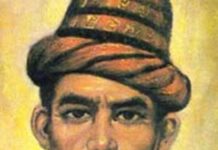
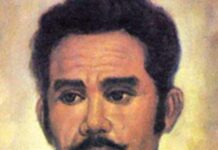
Tuanku Imam Bonjol was a prominent scholar, leader and fighter who fought against the Dutch in a war known as the Padri War in 1803-1837. Tuanku Imam Bonjol was born with the real name Muhammad Shahab in Bonjol in 1772. He was the son of Khatib Bayanuddin who was a religious scholar from Sungai Rimbang, Suliki, Fifty Cities with his wife Hamatun. As a local scholar and community leader, Muhammad Shahab or Tuanku Imam Bonjol has earned several titles, including Peto Syarif, Malin Basa, and Tuanku Imam. Tuanku nan Renceh from Kamang, Agam as one of the leaders of Harimau nan Salapan was the one who appointed him as the Imam (leader) for the Padri people in Bonjol. He himself eventually better known to the public as Tuanku Imam Bonjol.
The name Tuanku Imam Bonjol is known as an Islamic religious leader with a polite personality. The figure of Tuanku Imam Bonjol cannot be separated from the Padri until now. The Padri are the designation given to a group of people who are the main supporters of upholding religious symbols in the social order that was popular in the Minangkabau lands, especially during the Padri War.
This group is adherents of Islam who want the implementation of Islamic law as a whole in the Kingdom of Pagaruyung. Tuanku Imam Bonjol’s involvement in the Padri War began when he was asked to become the leader of the Padri in the Padri War after being appointed by Tuanku Nan Renceh as Imam in Bonjol. Tuanku Imam Bonjol was entrusted with becoming the leader and commander of the war after Tuanku Nan Renceh died.
Tuanku Nan Renceh is a member of Harimau Nan Salapan which is the designation for the leaders of several colleges who later become leaders of the Padri.
With his appointment as leader, now the command of the Padri is in the hands of Tuanku Imam Bonjol. As a leader, Tuanku Imam Bonjol must realize the ideals dreamed of by the previous leader of the Padri, even though he has to go through war.
The Padri War emerged as a means of the Padri (Ulama) in opposing the acts that were rife at that time among the people who were protected by local authorities in the Pagaruyung Kingdom, such as shirk (visiting sacred graves), gambling, cockfighting, the use of madat (opium), liquor, tobacco and generally easing the implementation of Islamic religious obligations.
The absence of an agreement from the Indigenous People who had embraced Islam to abandon this custom sparked the anger of the Padri, so that war broke out in 1803.
Until 1833, this war could be said to be a civil war involving fellow Minang and Mandailing. In this war, the Padri were initially led by Harimau Nan Salapan while the Indigenous people were led by Yang Tuan Tuan Pagaruyung, namely Sultan Arifin Muningsyah.
When they began to be pressed, the Indigenous people asked for help from the Dutch in 1821 which only complicated the situation, so that since 1833 the Indigenous people turned against the Dutch and joined the Padri. This war itself in the end this war can be won by the Dutch with great difficulty and in a very long time.
In October 1837, Tuanku Imam Bonjol was invited by the Dutch to Palupuh for negotiations. Arriving at that place, Tuanku Imam Bonjol was immediately arrested and exiled to Cianjur, West Java, then transferred to Ambon and finally to Lotak, Minahasa, near Manado. It was in this last place that Tuanku Imam Bonjol died on November 8, 1864. Tuanku Imam Bonjol was buried at the place of his exile.
During his leadership, Tuanku Imam Bonjol began to regret some of the acts of violence committed by the Padri against his brothers, as contained in his memory. Although on the other hand, this fanaticism also gave birth to an attitude of heroism and love for the motherland.
The struggle that has been carried out by Tuanku Imam Bonjol can be an appreciation for his heroism in opposing colonialism. As a tribute from the Indonesian government representing the Indonesian people in general, Tuanku Imam Bonjol was appointed as a National Hero of Indonesia since November 6, 1973.